Saturday, 30 August 2014

Ivy League - season three

"Everything is early this year" is the naturalists refrain, in complete contrast to last year - remember the non-existent spring?

Tonight was the fifth night the Stutton Moth Group (membership of two) had roamed the lanes checking the ivy flowers since the 20th August. Last year the flowering didn't start until the 12th September.
With flowering so early, we have been picking up a few late summer species, but the commonest three remain Large Yellow Underwing,  Square-spot Rustic and Angle Shades.  Intriguingly, Flounced Rustic, which would be verging on abundant in the moth trap,  is a species we have never recorded on ivy.

Last year we recorded 53 species around the village on ivy, so far this season we are on 28. New species tonight were Small Dusty Wave and a tatty Cloaked Minor. If we continue along these lines we should break the 60 barrier.

This really highlights how import ivy is as a nectar source for moths. By day, a seemingly endless stream of invertebrates descend on their flowers and this carries on at night. 

Sunday, 13 April 2014

Slivers of gold and a dessicated weasel

What a glorious day Thursday was. A blue sky, strewn with high clouds, flat calm and a t-shirt temperature. Good enough for a picnic with the family down at Stutton Ness.

Birds were going to be a bit of a side issue. I had my bird fix earlier in the morning with a summer-plumaged Slavonian Grebe in Holbrook Bay and my first Willow Warbler of the year near Stutton's very own Wolves Wood (not the RSPB one near Hadleigh).

Over the last couple of days, I have discovered a smart little moth Eriocrania subpurpurella.  It's a shiny little gold chap, the larvae of which mine oak leaves. It is quite common, but understandably over-looked. Now I have seen it once, they keep popping up whenever I find myself under an oak tree with a bit of herbage around it for the males to lek on. Well that is what they seem to be doing when the sun is out. Some of the day-flying micros really do warrant a closer look.


Eriocrania subpurpurella (I think)

When we got down to Stutton Ness my attention was drawn to the bare soil at the base of a fallen oak. As part of my tentative steps towards learning a bit more about bees and wasps, this seemed a likely spot.


Sure enough, my instincts proved correct. There was a bee-fly charging around (with apologies for image quality - just a point and shoot job):


Bee-fly Bombylius major

I then noticed another aculeate that at times seemed to be taking an interesting in the bee-fly. The wasp-like abdominal pattern and dangling legs certainly made it stand out (queue even worse shot):


Bee-fly with unidentified admirer

The mystery insect eventually settled and I managed a couple of record shots. I should be very grateful if anyone can identify it.


Was'at?

On the way back we came across this shrivelled fellow on the path. 


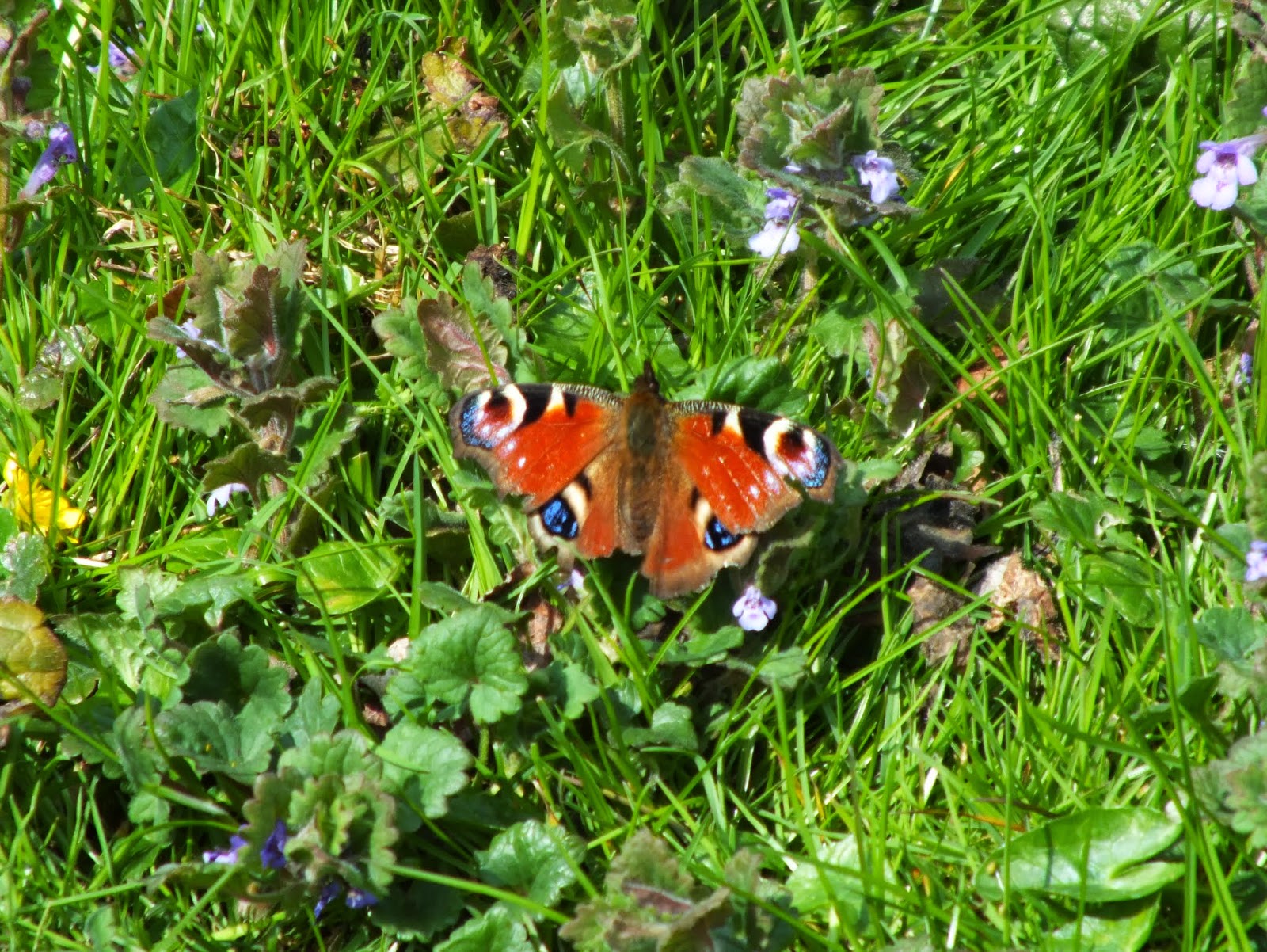
as well as a Peacock:


and a Blackcap:


Friday, 4 April 2014

And so it begins.

It has been very rewarding to see the increase in moths gracing the trap since the vice-Chairman of S.Mo.G. gave me his spare 30w actinic bulb. I had three Red Chestnut in the trap this morning (my only previous garden record was a single specimen on the 31 March 2012) and the first Muslin Moth of the year too.


But then comes the pitfall - or challenging identifications if you prefer, with an increase in Pugs. I can cope with Double-striped Pugs and Brindled Pugs (I think), but when you get half-a-dozen seemingly variable ones, a few doubts begin to surface. So by the powers of the internet, it is over to you to see what you think. All Brindled?


The full species list follows:

Common Quaker 64
Small Quaker 2
Hebrew Character 12
Clouded Drab 7
Early Grey 1
Twin-spotted Quaker 1
Double-striped Pug - 3
Chestnut 1
Pale Mottled Willow 1
E. postvittana 1
Red Chestnut 3
Garden Carpet 1
Muslin Moth 1

plus those pugs.

Sunday, 9 March 2014

A Drab affair?

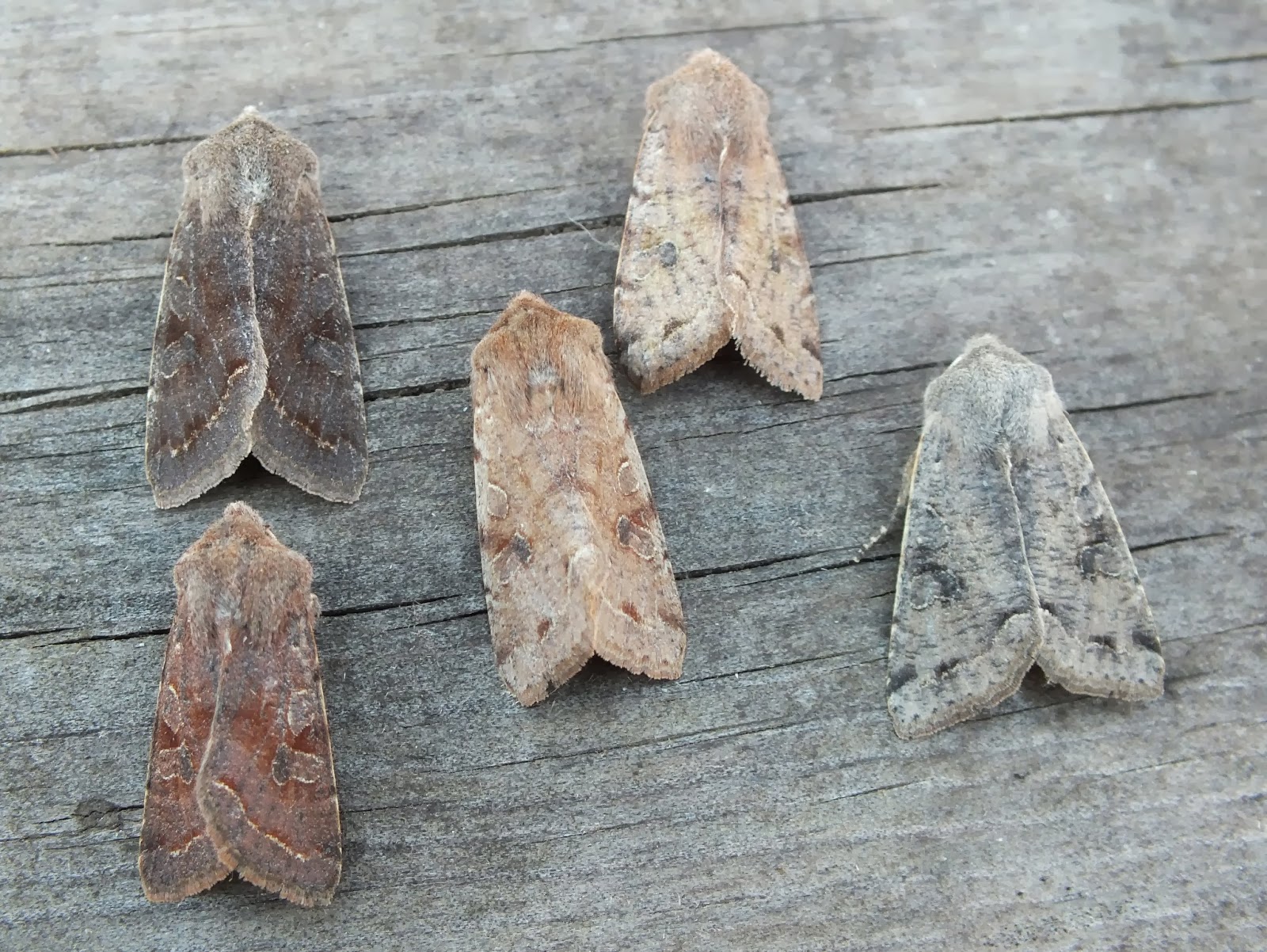
Another good selection of spring moths this morning, with more Drabs now on the wing. Below is a photo showing the variation that occur in Clouded Drab.


The greyness of the bottom right specimen had me thinking Lead-coloured Drab for a moment, but the pointed wings reassured me. Second, the bottom left specimen seemed a tad small and I still reserve some doubt over whether this is actually a dark-form Common Quaker. Any pointers/confirmation would be appreciated please. Here's the two darker 'Drabs' side-by-side, making it a little more obvious:


There was also a very ginger Common Quaker:


As well as two spring firsts - Twin-spotted Quaker and Early Moth:


Monday, 3 March 2014

Redpolls

Nearly two months since my last post, apologies, but had a hip replacement so not a great deal to report. On the cusp of returning to work now and I am sufficiently recovered to walk more than the paltry 100 metres or so that I was managing last year.

An email last night from fellow Stour Estuary-ite Richard Stace about a Mealy Redpoll at Larchwood Hide on Alton Water had my full attention. The drug that is patch birding needs feeding and recent dips on Med Gull and Black-necked Grebe needed dispelling.

So around 7.30am this morning, joined by Tony Fox, we strolled down in hope and expectation. Before we got to the hide, Richard had picked our prize up in some over-mature scrub, with a nice Lesser nearby for comparison. When we got to the hide, the first redpoll on the feeders was another (or the same) Mealy, again obligingly joined by a Lesser to assuage any doubts. A bonus came with a corking male Brambling - complete with bright orange breast band and darkening head.

With the morning brightening, coming back through Rabbet's Wood, the delicate song of Treecreeper held our attention. We dropped Tony off and when I got home, there was a message for me to get back there quick as he had one of these on his feeders:

Mealy and Lesser Redpoll

Saturday, 4 January 2014

Mr Paterson and ancient woodlands

Hearing the news this morning that the Secretary of State for the Environment believes 'off-setting' ancient woodland loss can be made acceptable by planting a larger number of trees elsewhere had me fuming. I read an article on the BBC website, heard more on Radio 4 and felt compelled to go and buy a copy of the Times just so that I had the facts in front of me.


white Early Purple Orchid in an ancient wood

Ancient woodlands are irreplaceable, an undeniable fact. The Times is right to point out that these woods have been standing since at least the year 1600,  but in many cases they were standing at the time of Domesday and probably millenia before - back to the last Ice Age. Ely Cathedral was built 900 years ago - would you ever see proposals to put a high-speed rail-line through that? There have been some remarkable examples of habitat creation over the last 20 years (Lakenheath Fen or Wallasea for example), but you won't see a conservation NGO stepping forward to recreate an ancient woodland.


Not many bendy ash trees like this in a plantation are there?

The man on the street, perhaps understandably, may think it is a very sensible proposition  to plant x number of new trees for every tree lost from an ancient woodland, but that is an appalling simplification for such a rich and complex habitat. There are a wealth of plants that can only be found in ancient woodlands as well as animals that have a prediliction for old woods. Citing two local examples there is Limax cinereoniger (a slug) and Propolydesmus testaceus (a millipede). What about the soil structure and the inter-relations that holds with the flora growing from it?


Wind-thrown ash tree: 1800 species of invertebrate rely upon dead wood.

When it comes to avoidable habitat loss, there has to be a line in the sand. In my opinion ancient woodlands should be sacrosanct.


Herb-Paris: has a strict association with ancient woods

There is no smoke without fire and it would seem that Mr Paterson has sparked the flames already with what he has said in The Times today. It can not be so.

Friday, 3 January 2014

Harrier heaven

I managed to get out on the patch for the third successive morning. Goldcrest was still missing from the Patchwork Challenge so I stopped off at the church first thing. The impression I formed on New Year's Day that the yews were being used as a blackbird roost gained further credence this morning with birds appearing from their dark depths. It was ten minutes before a Goldcrest deigned to call.

Not much was happening at Alton Water, there was no sign of the Black-throated Diver and the Yellowhammer flock along Alton Hall Lane was not showing either. The south-westerly still had a bit of oomph about it as I got down to Stutton Mill, but the sky was the best kind of blue and the sun was on my back. Red-breasted Mergansers were flirting out in the main channel: 41 of them, and then one of the Great Northern Divers that had been found a few days back hove in to view, followed by the second ten minutes later. The 75th species for the year in the village. Just Red-throated, White-billed and Pacific to go then for the patch. Red-throat being the scarcest regular diver on the estuary.

Feeling that my morning could not get much better, I stood at Stutton Mill Sluice (the parish boundary) for a scan of the reeds, fields and trees as it was approaching Buzzard o'clock (11am). There were a few crows bouncing up and down distantly over Brantham and I was delighted to pick up a female Marsh Harrier among them, rather than the expected Buzzard. A short time later, it popped up close by before disappearing behind some poplars. As I dropped my bins, my eyes fell upon a male Hen Harrier no more than 30 metres away. Unbelievable! It floated over the 'beet field before shaking up the saltmarsh roost. A wisp of 15 Snipe was a bonus from it's marauding. Hens that do make an appearance around the estuary are invariably ring-tails and normally don't come anywhere near me. Frustratingly for Chris, he had gone off to do some chores and missed it by minutes. Hopefully it will linger and next time I will not leave my camera in the car.

I did take the camera round to Mistley in the afternoon, where the godwits and Goldeneye were putting on a show.