Saturday, 13 April 2013

You're for it now

A momentous occasion yesterday - I bought a camera. It was a present from my parents for a forthcoming landmark birthday. With a knackered hip and a young family limiting birding opportunities nowadays, it seemed like a good thing to do. I ummed and erred over a couple in the store and eventually plumped for a Fuji HS30EXR. I could have spent 70% more on a Canon with a 50x optical zoom, but thought better of it in case it turned in to an expensive mistake.

So with the light streaming through the windows at dawn, I was out down to the reservoir to give the beast a try out. The dam was shrouded in mist, but sadly not in birds.


Heading back up to the Café, I bumped in to John who had set a couple of nets to try and bag the Bramblings that were still coming to the feeders. Within minutes of me turning up, he was extracting this young female:


Its a giant - look at the size of it compared to that car!


Dunnock


Yellowhammer

Wednesday, 10 April 2013

On the menu last night

What a difference a couple of 'mild' days make. Overnight temperatures also dared to break in to the positive.

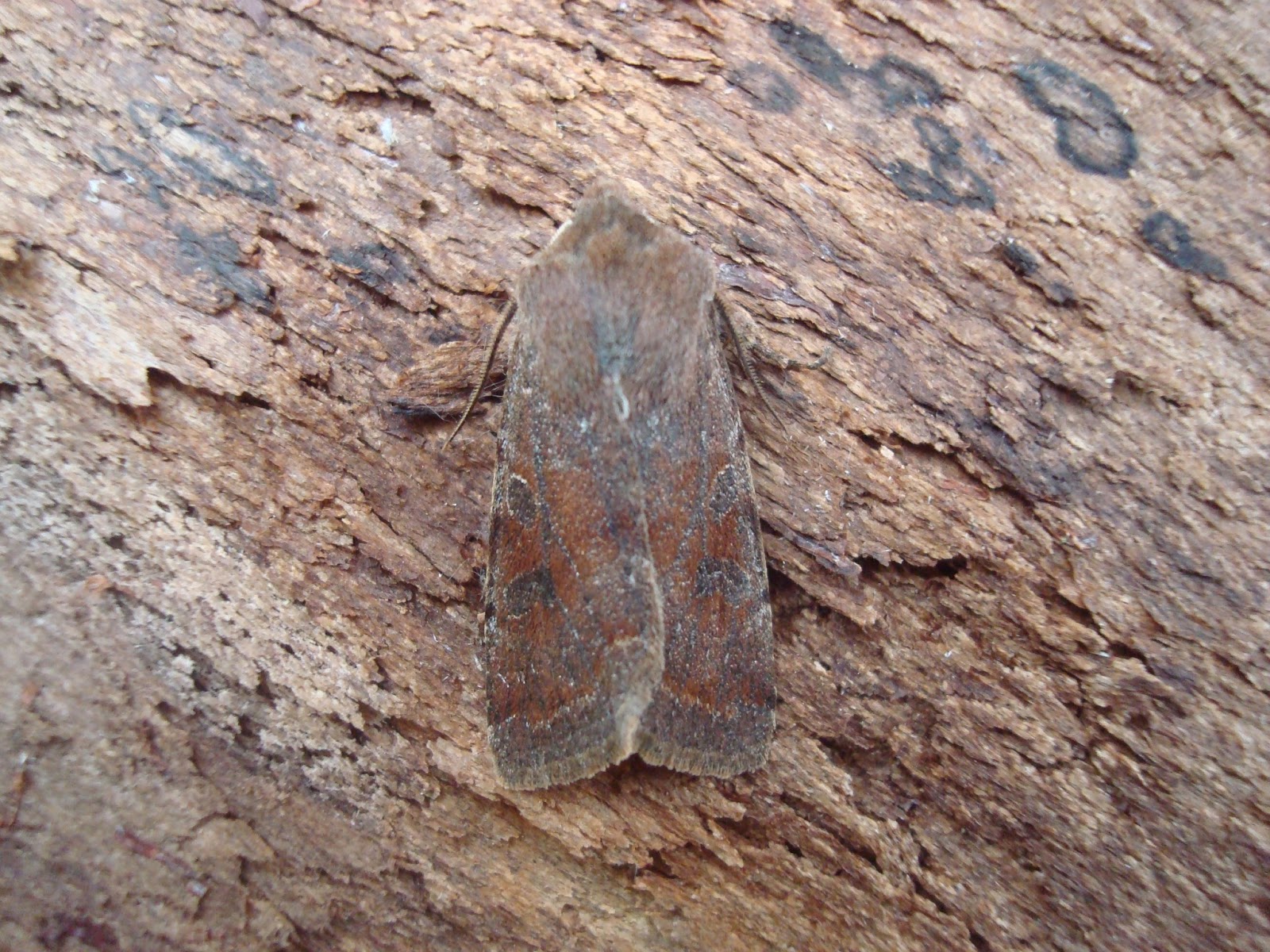
In the 15w actinic were 25 moths of 11 species:

Oak Beauty - 2
Hebrew Character - 3
Satellite - 1
Early Grey - 1
Common Quaker - 8
Clouded Drab - 4
March moth - 2
Twin-spotted Quaker - 1
Small Quaker - 1
Grey Shoulder-knot - 1 (first for the garden)
Chestnut - 1

Grey-shoulder Knot, Satellite and Chestnut over-winter as adults, whereas the other species spend the winter as pupa underground. The caterpillars of Early Grey feed on honeysuckle and the Grey-Shoulder-knot is an oak-feeder. The other species are not as fussy.

Grey Shoulder-knot (this is an image from one I took off ivy last autumn)

 
March Moth - not its typical resting posture

 
Twin-spotted Quaker (a fresher specimen than two nights ago)


Satellite - another individual off ivy last autumn


Clouded Drabs - a variable species (but will bow to greater knowledge if anyone thinks the paler specimen is a Lead-coloured Drab)


Common Quaker - a nice ginger one


Saturday, 6 April 2013

Pipits

I have got to the stage in my birding life, when I don't care if I make a mistake. Yesterday was one of those days, or was it? Your helpful comments would be welcome please.

A call from my patch birding neighbour had me hot footing up to the dam end of Alton Water reservoir, with my two year old in tow, staring at a cracking summer-plumaged pipit. I will say now, that my first words were "you have a Scandinavian Rock Pipit here". I don't know why, from the depths of my birding brain (when I actually did a fair bit) it just felt like one. I know "it just felt like one" doesn't hold much truck with a rarities committee. Anyway, twenty minutes later, we were walking away talking about and yes, I put out the news, of a summer-plumaged Water Pipit. White outer tail, brown mantle, no malar, stonking supercilium. Easy. Was I conveniently glossing over the lack of wingbars or shall I blame my nose-diving son for not giving the bird fuller attention?

Later the afternoon, a few record shots came my way and here they are:


I received the top one first and the mantle colour seems 50/50 between grey and brown, which immediately cast doubt on my original ID. I then received image two and three, which sent me back towards water pipit.

Now I think: sod it, blog it, stick it on Twitter and see what people say. Just be polite about it please.

Tuesday, 2 April 2013

Desperate times

The one saving grace about today was the sun. In the wildlife garden at work it was sheltered from the biting easterlies and my balding noggin actually caught a bit of colour. The less than cheery news on the radio later was that the average temperature in March was the lowest in England since records began (in 1910).

An indication of what this prolonged cold spell has done to our wildlife was evident from the takings in the moth trap over the last two nights at work. There, I am able to run a 125W Mercury Vapour lamp which typically pulls in a greater range and volume of species than the 15W actinic I run at home. On Monday, I awoke to a frost-free morning, but there was not a single moth in the trap. Today, numbers rocketed. A March Moth and a Hebrew Character. Two moths. Abject. The Hebrew Character was a very fresh specimen and I suspect that it had been encouraged by the slight increase in daytime temperature to brave emergence.

Looking back on my own garden figures for March last year, on occasion I was catching over 100 moths. Admittedly, the species diversity wasn't great, but nevertheless there were plenty of moths about doing their thing, laying eggs and from which will have come the millions of caterpillars required on which many of our resident and migrant songbirds would gorge. There is a lovely stat in a Butterfly Conservation publication which estimates our 8 million Blue Tits get through 35 billion caterpillars every year.

With this delayed emergence, it makes me wonder what effect this will have for our breeding bird populations over the next couple of months, remembering that last year was also so bad. Results from the BTO's Constant Effort Sites scheme showed Blue Tit and Great Tit productivity down by over 30% in 2012.

Happy days.


Thursday, 28 March 2013

Swifts - coming soon

It is still bitterly cold out there and there is a barely a sniff of spring in the air.The dawn chorus is feeble, with just Blackbird and Dunnock trying to wake me up before first light.

However, I know that in a little over a month's time, Swifts will be back, returning to their historical nest sites. One of them is our house. The outside of the house was painted last summer and it was only after the decorators had finished, that I noticed they had blocked up some gaps on the end of the eaves. Full marks to them for such attention to detail, but it has stuffed things up as a potential nest site for swifts and starlings that have both nested, or tried to nest, in those gaps before.

A solution was sought and we are now the proud owner of two RSPB branded Swift boxes.


Just to refresh my memory as to their plight, I had a look at the Swift Conservation website. Some of the stats charting the decline of Swifts are extremely depressing. It is important to highlight what the problems are, but it is much more important to find workable solutions and I would urge anyone reading this to have a look at the website www.swift-conservation.org.uk If the boxes alone don't do the job, I have bought the CD of screaming swifts in the hope that this proves irresistable. 

Monday, 21 January 2013

Are you Norwich* in disguise?

It came as a great and welcome surprise to see the mighty Stutton lying second on one of the inaugural Patchwork Challenge tables last week. Admittedly, the table was formed from only 75 of the 200 or so Patches entered, so for all I know the other 125 could be sitting on 100+ species already and were just waiting until the month end to put their scores in. Maybe they were doing the right thing and actually birding rather than blogging about it.

Since the NYD thrash around for 76 species, matters have slowed down considerably. At the time of writing I have edged up to 90 species with the only additional two-pointer being a red-head Smew from the hides on Alton Water. Still present today so the vice-Chairman of S.M.O.G. tells me. Unfortunately for me, the five Eider that I saw off the barge a fortnight ago where just outside my patch, but fortunately for my neighbour Richard, they were in his (Holbrook). In the spirit of fairplay, I did phone him and he was able to add this Stour Estuary mega to his list for two points.

My two-point tally is represented so far by that Smew, the Great Northern Diver, Slavonian Grebe and, for us southerners, the generously handicapped Little Egret and Dark-bellied Brent Goose. I am rather disappointed that Pink-footed Goose only scores one point - but we can't have it all our own way. Richard on the other hand has jammed a Waxwing opposite his house and more skilfully picked up a Firecrest and several other two-pointers. I am not at all bitter that he saw this in an area where our Patches overlap.

On the "Need it" list still and what I would judge to be realistically attainable over the next 5-6 weeks are Kingfisher, Goosander, Linnet (what is the world coming to), Avocet, Grey Wagtail, Little Owl, Barn Owl and Water Rail. Other stuff that is around and could do me the kindness of showing up are Shag, Common Scoter, Long-tailed Duck (becoming more of a long shot), Marsh Harrier and Scaup. Another scarce grebe or diver would be nice, as would a grey goose (Tundra Bean or White-front please). The herd of 500 plastic Greylags has so far delivered the aforementioned Pink-foot and a bonus Barnacle. I might have to go and torch some fields for Woodcock as well. So if all of that lot puts in a show, we should still be flying high.

*This is where I refer you back to the title. You know how it is at the start of the football season (or any other sport you care to follow), when a team outside of the big four has a good start and then they just tail off. Stutton and Holbrook, I fear, are in that bracket. They are very good winter birding spots, but if you want a slice of migrant heaven, look elsewhere. Or maybe, just maybe, I shall be singing a different tune by the end of May...

Collared Flycatcher anyone?

Wednesday, 2 January 2013

One for Sorrow

After a thirteen year break, I am back on the listing game. As far as I am concerned though, this is an entirely admirable and green one. Three square kilometres all within an easy cycle of the front door. The Patchwork Challenge was duly accepted in Stutton and after a late New Year's Eve night, I was out the door on the bike at 7.30. Two years ago on New Year's Day I had gone round the village and amassed 76 species - surely with a more concerted effort this time around I was going to stroll in to 80+ territory?

There were several birds in the patch that needed targeting as there was no guarantee they would be around in the future. My plan was to work the parts of Alton Water that lie within the Stutton parish boundary first - which fortunately includes the hides in Larch Wood; then down to Stutton Ness for Slavonian Grebes (the best site for this species in eastern England don't you know) and then finish off at Stutton Mill for the high tide wader roost and the possibility of an owl or two.

There was a bite in the wind, but the sky was clear and so, unfortunately, was the Dam end of the reservoir where I was hoping to see the majestic Great Northern Diver that had been around for a week or so. Recompense came with a Pink-footed Goose that flew in with the Greylag flock. My only other village pink-foot was on NYD two years ago. On that day, I also had a female Ruddy Duck - I haven't seen one since.

Passing the cafe, there was no sign of any Waxwings that had been around on Christmas Eve, but some welcome wheezy notes allowed me to tick off Brambling. A potentially tricky bird for such a compact patch.

Next stop was the hides for the four Smew that had been frequenting Larchwood Bay. They weren't around either - maybe there were in conference with the diver somewhere? By the time I left the hides at 9.15 I was up to 45 species and things seemed promising. A quick stop at my Uncle's house added Tree Sparrow and Lesser Redpoll. House Sparrow came after and was my 51st species. What a sorry state of affairs I thought.

After a quick family stop off, I was out the door ready for Stutton Ness when I got a text to say that the diver had appeared back at the dam. So off I went. (patchchallenge)Tick!

I didn't reach Stutton Ness until Midday and the Slavonian Grebes took an age to appear. The chop on the water didn't help and the low, strong, winter sunshine also inhibiting viewing. That's my excuse for not seeing Shag or Long-tailed Duck anyway. One day I will get to Stutton Ness and see Shorelark or Snow Bunting, but New Year's Day there is a veritable Piccadilly Circus. A Rock Pipit obliged by dropping in for number 70.

Most 'daylist' days, have their blackspots and mine, regrettably, was Stutton Mill. By the time I was there just after 2pm the wind was stronger still and the tide was very high. Poor judgement on my part. I was only able to add a measly four waders, but Bar-wit, Avovet and Pintail all eluded me. So what next? I decided to hack it up the hill and back to the hides to see if the Smew had reappeared. A strip of game cover en-route enabled me to add Reed Bunting for 75, but I was still shy of Grey Heron, Fieldfare, Stock Dove, Mistle Thrush, Great Spotted Woodpecker, Canada Goose and Magpie! Why, oh why should I be getting upset about seeing a Magpie? For the second time, the hides drew a Smew-blank and I was left with a last desperate look for the Waxwings around the now much-busier car park. No joy, but I did see a Magpie.