My birding exploits have been fairly thin of late, so I had been looking forward to Bank Holiday Monday awhile for another go at seeing if we (Ed, Richard, Suzanne and I) could rustle up a hundred species around our part of the Stour Estuary.
Last year three of us got agonisingly close with 98 - oh how we cursed Bullfinch and Treecreeper. Suzanne was able to join us for a few hours this time round before work. The plan was a 4-ish start at Alton Water to mop up the singers, bump down to Lower Holbrook for low water lingering waders, then dip in to Stutton Mill and the Factory Roost at Brantham before working in the added bonus of some known promise on White Horse Marsh (on the back of Cattawade Marshes), before hitting the RSPB bit. Simple.
Conditions were blessedly dry with a south-westerly, which at times in the early morning was just a little too keen. Bar the nightingales at Alton Water, the dawn chorus was not overwhelming. A Barn Owl at 4.30am was the first bonus bird of the day having failed with them in 2014, but it took me until 4.55am to clean my ears out and finally hear a Tawny Owl. Last year, we had four different birds hooting simultaneously. The wind also kept the Cuckoo volume down and we left Alton Water with a third of one and perhaps more worryingly two-thirds of a Kingfisher. How one us failed to hear and then see a blue and orange flash right under our noses, we shall never know! 6am and we were on 45 species.
En route to Lower Holbrook, we made a brief stop in Stutton village to bag House Sparrow, Starling and Greenfinch. What is the world coming to when you have to factor in such a stop for three once super-common birds?
Holbrook Bay was kind to us with Whimbrel, Knot, Grey Plover and Ringed Plover out on the mud. A real bonus was a first-year Med Gull that Ed picked up among a small group of similarly-aged Common Gulls. Much to our relief, a Kingfisher flipped over the seawall to restore parity and as we headed back to the car, the only Sand Martin of the day whipped past. Before Suzanne left for work, she exercised her rights with a key to get us in to a Bullfinch-rich piece of woodland. Thanks Suzanne! Always a potential pitfall on a bird-race, Richard got us on to a Little Owl before we headed to the dam at Alton Water. 8.05am - 79 species.
Maintaining its reputation for being the armpit of spring migration, the only new bird we added at the dam was House Martin. The "there should be a Wheatear here" rabbit burrows on the dam slope were typically void of Wheatears.
Breakfast took the form of a Mars Bar, pork pie and a can of Red Bull (a combination I can recommend) which spurred us on to Stutton Mill. Once we hit 80, we knew that things would slow down and thoughts would turn to missed opportunities and species we could realistically add. A drake wigeon snoozing on the mud was almost overlooked and a Common Sandpiper were the highlights here. As we departed, a flyover Grey Heron turned out to be the only one that day and we may have missed that had we not stopped to chat to the local grazier.
The local male Marsh Harrier was number ninety for the day as we trotted down to the Factory Roost in Seafield Bay. The tide was rising and thoughts turned to waders like Barwit or Turnstone that had eluded us so far. As we stood on the seawall, a Water Rail squealed in the reeds behind us and we almost squealed in celebration! We failed with the waders.
Next, we pulled up at the RSPB office and whilst making a quick coffee, a Hobby blasted over and another Water Rail cranked up in the reedbed. Over the preceding week, White Horse Marsh on the Suffolk side of Cattawade Marshes, has been looking really good. Wood Sandpiper, Ruff, Greenshank, Shoveler and Teal had all been seen and all duly obliged - 97 before midday.
Exercising staff rights, we drove on to Cattawade where a Meadow Pipit squeaked on a post right next to us and Avocet were obvious. Scanning the loafing group of Tufted Duck, there sat our prize, a female Pochard taking us to the hundred at 12.30. Joy all round, but it begged the question, what do we do next? Realistically, there were very few birds left that we could consider "guaranteed" locally. We hadn't seen Great Black-backed Gull, so decided to check Hogmarsh behind the Co-Op in case one had decided to sit on the high tide roost. The tide was right up, which made that a non-starter. However, scoped about a kilometre from us by Richard was a gang of Turnstone roosting on the bow-sprit of a moored boat. The blackwits on Hogmarsh then went nuts when a Peregrine pitched up, taking us to 102.
Given that we had reached our target, we decided to stretch the boundary a bit and head for Flatford for Grey Wagtail and Turtle Dove. We ended up walking back to Cattawade, patiently staking out a Turtle Dove gritting area. Regrettably, the number of walkers meant this didn't work out. Three hours were spent without adding another species, but as we headed back to Flatford a Cuckoo cranked up, lifting us to 103. Perseverance paying off.
We knew that Turtle Doves were likely at Stutton Ness, and Bradfield Bay or another go at Holbrook Bay could garner the gull or a bar-wit, but a sense of acheiving the milestone 100 in such a small area around a fabulous estuary and the fact that we had been on the go for 13 hours, made us decide to call it a day. But not before we wangled a Great Spotted Woodpecker to take us to 104.
Tuesday, 5 May 2015

Tuesday, 14 October 2014
Sixty!
Proceedings looked good for another check of the ivy this evening if the Red-Green Carpet on the bathroom ceiling and Mallow on the kitchen window were anything to go by.

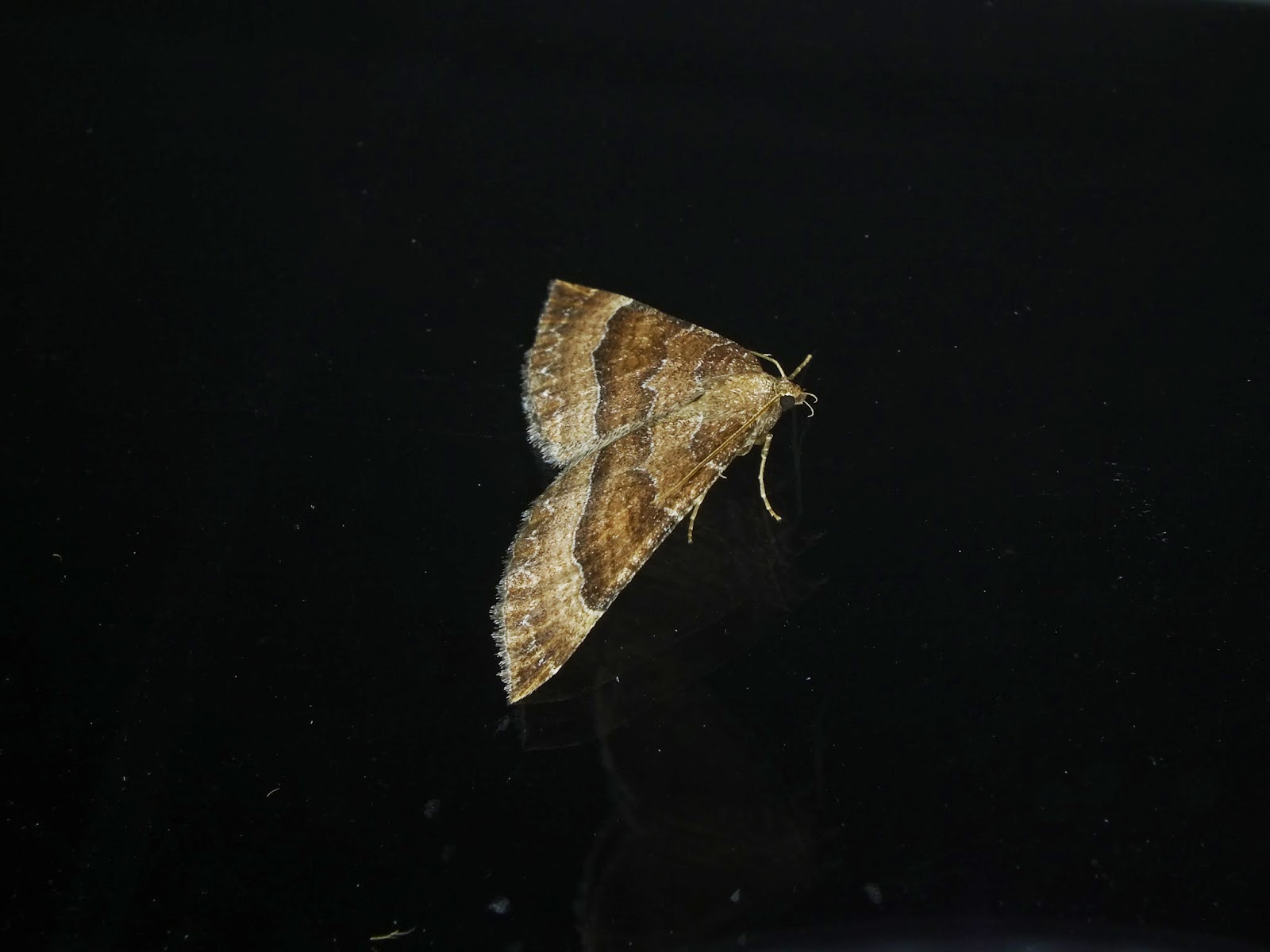


I invited a friend along who had an expressed an interest and after half-an-hour was beginning to wish I hadn't, as all we had to show for it was a single Angle Shades. Things picked up a little as we turned the corner and worked the lee side, with the first of three Yellow-line Quakers.
Salvation came in the form of the first Satellite of the season, which was also the sixtieth species of moth we have recorded on ivy in Stutton this year.
I reckon the 50mm+ of rain we have had over the last couple of days has wiped the slate clean. There is talk of another warm spell at the weekend which may liven things up again for one last time. Still no Merveille du Jour...
Friday, 10 October 2014
Windy but worth it
Very mild this evening, but the wind was blowing up to Force 4 along the exposed stretch that I was checking. The moths, like any sensible creature, were mostly feeding on the lee side. Just 13 moths in total, but ten species, with three new for the season - Red-line Quaker, Green-brindled Crescent and Chestnut. I say three, but it could be four. I photographed this one, but was unable to pot it up and my initial thought was that it was a Dark Chestnut. Thoughts welcome.


..and the second Grey Shoulder-Knot.

This was the first Red-line Quaker of the season...
..and the second Grey Shoulder-Knot.
The very fresh Green-brindled Crescent is in the fridge awaiting photography tomorrow.
Sunday, 5 October 2014
And the record falls
Only the second "breath-frosting" night of the ivy league season tonight and a moon almost full, veiled by thin cloud. Less than ideal conditions, but at least it was calm and I hadn't been out since the 28th. There was an Angle Shades on my ivy in the front garden, so that boded well as I headed off down the lane towards the church.
In a little over an hour, I noted 27 moths of 12 species, with three new for the season. That takes the total in twenty visits since the 20th August to 55 species, taking us past last year's effort of 53. We are well on target to get to sixty, but I would settle for 54 mind, if that was a Merveille du Jour!
Totals as follows:
Angle Shades - 6
Common Marbled Carpet - 3
Grey Shoulder-knot - 1
Lunar Underwing - 5
Yellow-line Quaker - 1
Dusky-lemon Sallow - 1
Square-spot Rustic - 2
Brick - 4
Large Yellow Underwing - 1
Beaded Chestnut - 1
Deep-brown Dart - 1
L-album Wainscot - 1


In a little over an hour, I noted 27 moths of 12 species, with three new for the season. That takes the total in twenty visits since the 20th August to 55 species, taking us past last year's effort of 53. We are well on target to get to sixty, but I would settle for 54 mind, if that was a Merveille du Jour!
Totals as follows:
Angle Shades - 6
Common Marbled Carpet - 3
Grey Shoulder-knot - 1
Lunar Underwing - 5
Yellow-line Quaker - 1
Dusky-lemon Sallow - 1
Square-spot Rustic - 2
Brick - 4
Large Yellow Underwing - 1
Beaded Chestnut - 1
Deep-brown Dart - 1
L-album Wainscot - 1
Common Marbled Carpet
Brick
Angle Shades
Saturday, 20 September 2014
Night time macro photography for beginners
I am a terrible photographer. I bought a bridge camera last year and until this week I have reserved the right to keep the settings on 'auto'. The results have been so mediocre, that I had been resorting to using my smartphone instead.
However, last week, I dusted off the cheap (less than £20) ring-flash I had bought a few months ago and decided to give it a try whilst out recording moths on ivy. Here's a Large Yellow Underwing taken on auto setting as an example:

On Wednesday, I invited Steve Plume to join Tony and I to see what he could manage. His ring-flash rig cost a little short of £500! He gave me a few handy hints about various settings (which for a change I actually understood). His snort of derision when he saw the 'auto' setting said it all. Here are a couple of images post-5 minute masterclass


However, last week, I dusted off the cheap (less than £20) ring-flash I had bought a few months ago and decided to give it a try whilst out recording moths on ivy. Here's a Large Yellow Underwing taken on auto setting as an example:
On Wednesday, I invited Steve Plume to join Tony and I to see what he could manage. His ring-flash rig cost a little short of £500! He gave me a few handy hints about various settings (which for a change I actually understood). His snort of derision when he saw the 'auto' setting said it all. Here are a couple of images post-5 minute masterclass
Angle Shades
Straw Dot
Brimstone (moth)
I have also started using the ring-flash during the day to erase that shadowing effect you often get. I was pleased with this Dusky-Lemon Sallow (on auto),
whilst this unusually marked Oak Nycteoline was taken after Steve had advised:
Saturday, 30 August 2014
Ivy League - season three
"Everything is early this year" is the naturalists refrain, in complete contrast to last year - remember the non-existent spring?
Tonight was the fifth night the Stutton Moth Group (membership of two) had roamed the lanes checking the ivy flowers since the 20th August. Last year the flowering didn't start until the 12th September.
With flowering so early, we have been picking up a few late summer species, but the commonest three remain Large Yellow Underwing, Square-spot Rustic and Angle Shades. Intriguingly, Flounced Rustic, which would be verging on abundant in the moth trap, is a species we have never recorded on ivy.
Last year we recorded 53 species around the village on ivy, so far this season we are on 28. New species tonight were Small Dusty Wave and a tatty Cloaked Minor. If we continue along these lines we should break the 60 barrier.
This really highlights how import ivy is as a nectar source for moths. By day, a seemingly endless stream of invertebrates descend on their flowers and this carries on at night.

Sunday, 13 April 2014
Slivers of gold and a dessicated weasel
What a glorious day Thursday was. A blue sky, strewn with high clouds, flat calm and a t-shirt temperature. Good enough for a picnic with the family down at Stutton Ness.
Birds were going to be a bit of a side issue. I had my bird fix earlier in the morning with a summer-plumaged Slavonian Grebe in Holbrook Bay and my first Willow Warbler of the year near Stutton's very own Wolves Wood (not the RSPB one near Hadleigh).
Over the last couple of days, I have discovered a smart little moth Eriocrania subpurpurella. It's a shiny little gold chap, the larvae of which mine oak leaves. It is quite common, but understandably over-looked. Now I have seen it once, they keep popping up whenever I find myself under an oak tree with a bit of herbage around it for the males to lek on. Well that is what they seem to be doing when the sun is out. Some of the day-flying micros really do warrant a closer look.

When we got down to Stutton Ness my attention was drawn to the bare soil at the base of a fallen oak. As part of my tentative steps towards learning a bit more about bees and wasps, this seemed a likely spot.

Sure enough, my instincts proved correct. There was a bee-fly charging around (with apologies for image quality - just a point and shoot job):

I then noticed another aculeate that at times seemed to be taking an interesting in the bee-fly. The wasp-like abdominal pattern and dangling legs certainly made it stand out (queue even worse shot):



Birds were going to be a bit of a side issue. I had my bird fix earlier in the morning with a summer-plumaged Slavonian Grebe in Holbrook Bay and my first Willow Warbler of the year near Stutton's very own Wolves Wood (not the RSPB one near Hadleigh).
Over the last couple of days, I have discovered a smart little moth Eriocrania subpurpurella. It's a shiny little gold chap, the larvae of which mine oak leaves. It is quite common, but understandably over-looked. Now I have seen it once, they keep popping up whenever I find myself under an oak tree with a bit of herbage around it for the males to lek on. Well that is what they seem to be doing when the sun is out. Some of the day-flying micros really do warrant a closer look.
Eriocrania subpurpurella (I think)
When we got down to Stutton Ness my attention was drawn to the bare soil at the base of a fallen oak. As part of my tentative steps towards learning a bit more about bees and wasps, this seemed a likely spot.
Sure enough, my instincts proved correct. There was a bee-fly charging around (with apologies for image quality - just a point and shoot job):
Bee-fly Bombylius major
Bee-fly with unidentified admirer
The mystery insect eventually settled and I managed a couple of record shots. I should be very grateful if anyone can identify it.
Was'at?
On the way back we came across this shrivelled fellow on the path.
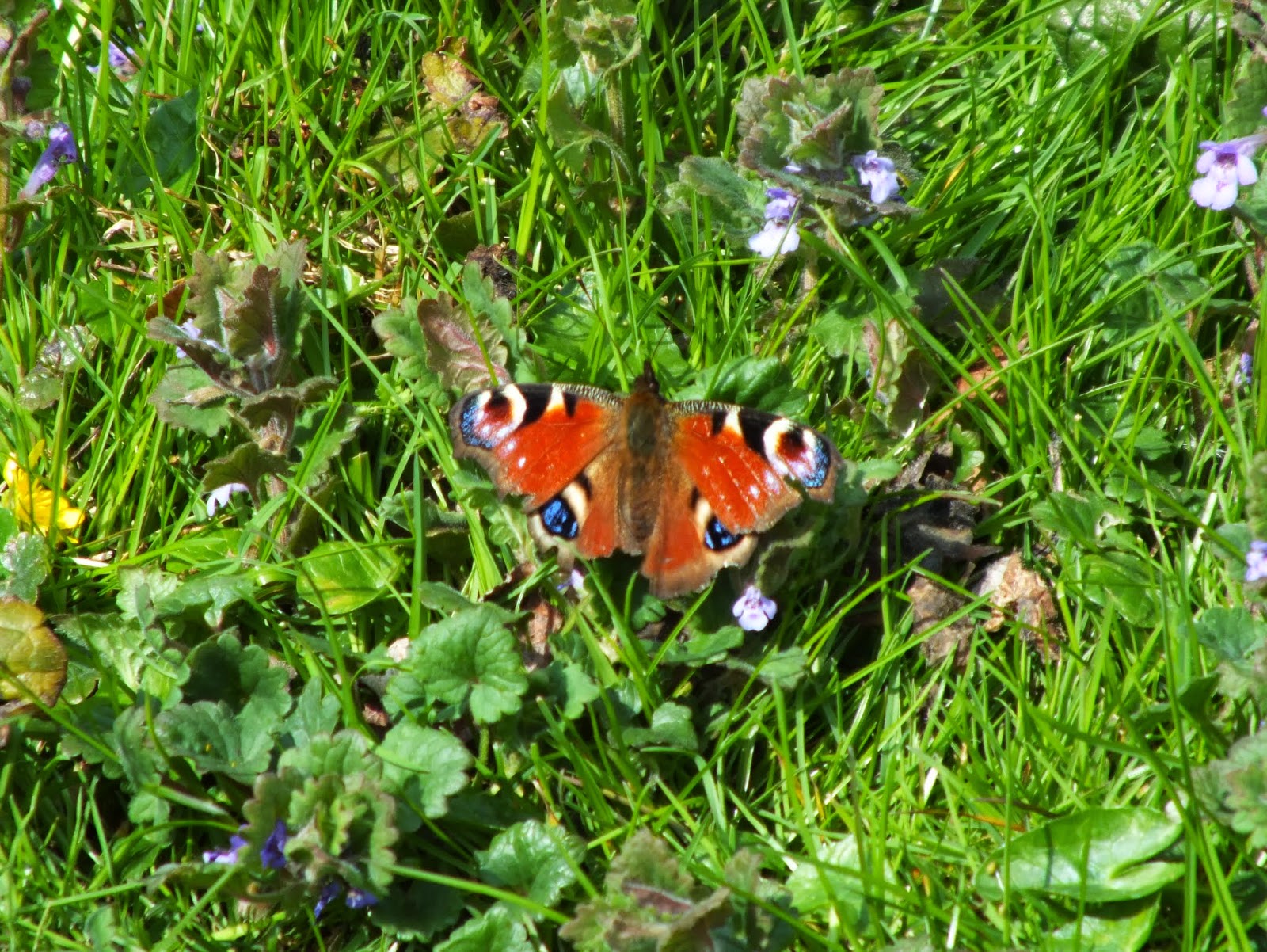
as well as a Peacock:
and a Blackcap:
Friday, 4 April 2014
And so it begins.
It has been very rewarding to see the increase in moths gracing the trap since the vice-Chairman of S.Mo.G. gave me his spare 30w actinic bulb. I had three Red Chestnut in the trap this morning (my only previous garden record was a single specimen on the 31 March 2012) and the first Muslin Moth of the year too.


But then comes the pitfall - or challenging identifications if you prefer, with an increase in Pugs. I can cope with Double-striped Pugs and Brindled Pugs (I think), but when you get half-a-dozen seemingly variable ones, a few doubts begin to surface. So by the powers of the internet, it is over to you to see what you think. All Brindled?
The full species list follows:
Common Quaker 64
Small Quaker 2
Hebrew Character 12
Clouded Drab 7
Early Grey 1
Twin-spotted Quaker 1
Double-striped Pug - 3
Chestnut 1
Pale Mottled Willow 1
E. postvittana 1
Red Chestnut 3
Garden Carpet 1
Muslin Moth 1
plus those pugs.
Sunday, 9 March 2014
A Drab affair?
Another good selection of spring moths this morning, with more Drabs now on the wing. Below is a photo showing the variation that occur in Clouded Drab.
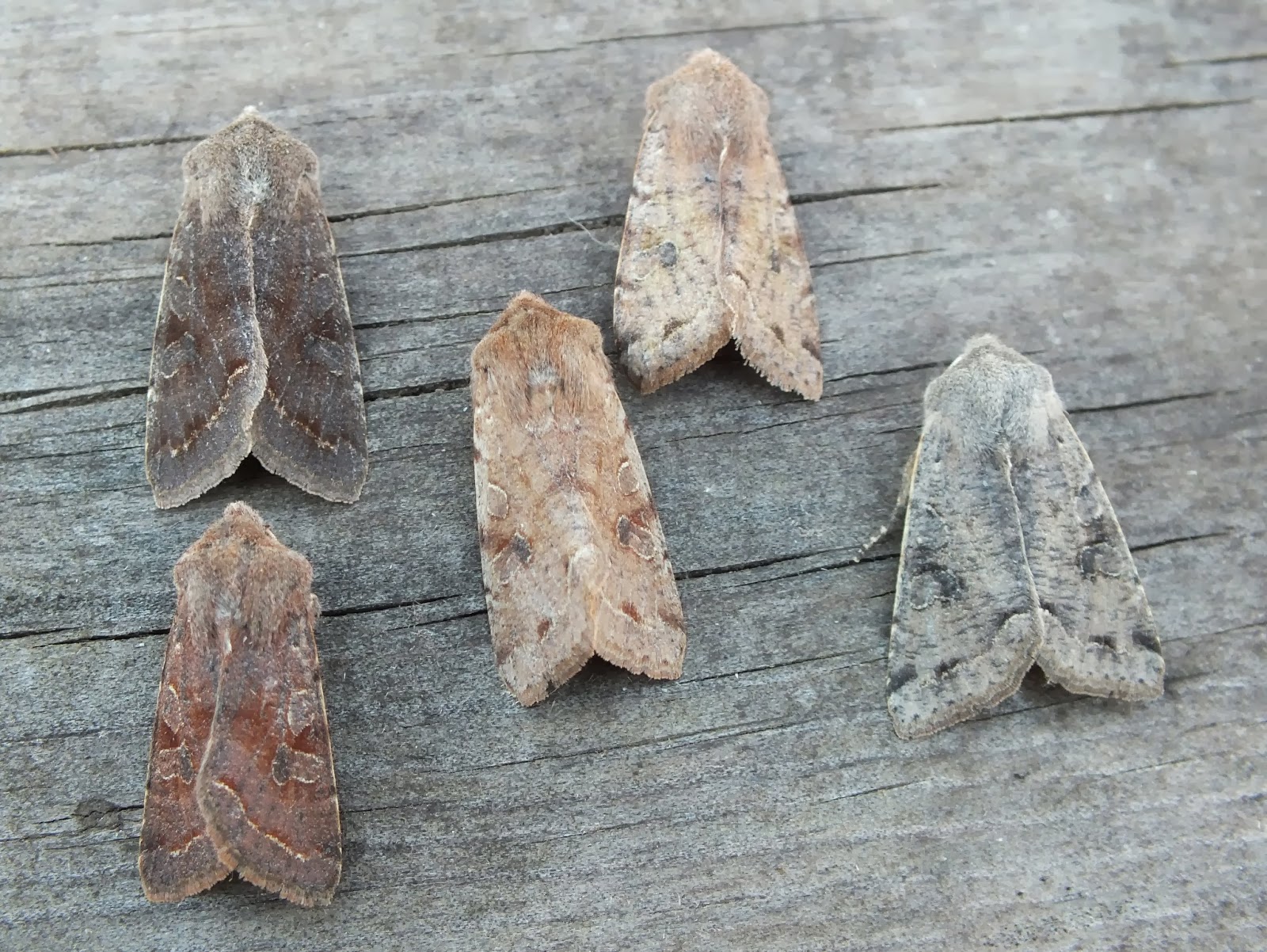


The greyness of the bottom right specimen had me thinking Lead-coloured Drab for a moment, but the pointed wings reassured me. Second, the bottom left specimen seemed a tad small and I still reserve some doubt over whether this is actually a dark-form Common Quaker. Any pointers/confirmation would be appreciated please. Here's the two darker 'Drabs' side-by-side, making it a little more obvious:
There was also a very ginger Common Quaker:
As well as two spring firsts - Twin-spotted Quaker and Early Moth:
Monday, 3 March 2014
Redpolls
Nearly two months since my last post, apologies, but had a hip replacement so not a great deal to report. On the cusp of returning to work now and I am sufficiently recovered to walk more than the paltry 100 metres or so that I was managing last year.
An email last night from fellow Stour Estuary-ite Richard Stace about a Mealy Redpoll at Larchwood Hide on Alton Water had my full attention. The drug that is patch birding needs feeding and recent dips on Med Gull and Black-necked Grebe needed dispelling.
So around 7.30am this morning, joined by Tony Fox, we strolled down in hope and expectation. Before we got to the hide, Richard had picked our prize up in some over-mature scrub, with a nice Lesser nearby for comparison. When we got to the hide, the first redpoll on the feeders was another (or the same) Mealy, again obligingly joined by a Lesser to assuage any doubts. A bonus came with a corking male Brambling - complete with bright orange breast band and darkening head.
With the morning brightening, coming back through Rabbet's Wood, the delicate song of Treecreeper held our attention. We dropped Tony off and when I got home, there was a message for me to get back there quick as he had one of these on his feeders:

An email last night from fellow Stour Estuary-ite Richard Stace about a Mealy Redpoll at Larchwood Hide on Alton Water had my full attention. The drug that is patch birding needs feeding and recent dips on Med Gull and Black-necked Grebe needed dispelling.
So around 7.30am this morning, joined by Tony Fox, we strolled down in hope and expectation. Before we got to the hide, Richard had picked our prize up in some over-mature scrub, with a nice Lesser nearby for comparison. When we got to the hide, the first redpoll on the feeders was another (or the same) Mealy, again obligingly joined by a Lesser to assuage any doubts. A bonus came with a corking male Brambling - complete with bright orange breast band and darkening head.
With the morning brightening, coming back through Rabbet's Wood, the delicate song of Treecreeper held our attention. We dropped Tony off and when I got home, there was a message for me to get back there quick as he had one of these on his feeders:
Mealy and Lesser Redpoll
Saturday, 4 January 2014
Mr Paterson and ancient woodlands
Hearing the news this morning that the Secretary of State for the Environment believes 'off-setting' ancient woodland loss can be made acceptable by planting a larger number of trees elsewhere had me fuming. I read an article on the BBC website, heard more on Radio 4 and felt compelled to go and buy a copy of the Times just so that I had the facts in front of me.


The man on the street, perhaps understandably, may think it is a very sensible proposition to plant x number of new trees for every tree lost from an ancient woodland, but that is an appalling simplification for such a rich and complex habitat. There are a wealth of plants that can only be found in ancient woodlands as well as animals that have a prediliction for old woods. Citing two local examples there is Limax cinereoniger (a slug) and Propolydesmus testaceus (a millipede). What about the soil structure and the inter-relations that holds with the flora growing from it?


There is no smoke without fire and it would seem that Mr Paterson has sparked the flames already with what he has said in The Times today. It can not be so.
white Early Purple Orchid in an ancient wood
Ancient woodlands are irreplaceable, an undeniable fact. The Times is right to point out that these woods have been standing since at least the year 1600, but in many cases they were standing at the time of Domesday and probably millenia before - back to the last Ice Age. Ely Cathedral was built 900 years ago - would you ever see proposals to put a high-speed rail-line through that? There have been some remarkable examples of habitat creation over the last 20 years (Lakenheath Fen or Wallasea for example), but you won't see a conservation NGO stepping forward to recreate an ancient woodland.
Not many bendy ash trees like this in a plantation are there?
The man on the street, perhaps understandably, may think it is a very sensible proposition to plant x number of new trees for every tree lost from an ancient woodland, but that is an appalling simplification for such a rich and complex habitat. There are a wealth of plants that can only be found in ancient woodlands as well as animals that have a prediliction for old woods. Citing two local examples there is Limax cinereoniger (a slug) and Propolydesmus testaceus (a millipede). What about the soil structure and the inter-relations that holds with the flora growing from it?
Wind-thrown ash tree: 1800 species of invertebrate rely upon dead wood.
When it comes to avoidable habitat loss, there has to be a line in the sand. In my opinion ancient woodlands should be sacrosanct.
Herb-Paris: has a strict association with ancient woods
Friday, 3 January 2014
Harrier heaven
I managed to get out on the patch for the third successive morning. Goldcrest was still missing from the Patchwork Challenge so I stopped off at the church first thing. The impression I formed on New Year's Day that the yews were being used as a blackbird roost gained further credence this morning with birds appearing from their dark depths. It was ten minutes before a Goldcrest deigned to call.
Not much was happening at Alton Water, there was no sign of the Black-throated Diver and the Yellowhammer flock along Alton Hall Lane was not showing either. The south-westerly still had a bit of oomph about it as I got down to Stutton Mill, but the sky was the best kind of blue and the sun was on my back. Red-breasted Mergansers were flirting out in the main channel: 41 of them, and then one of the Great Northern Divers that had been found a few days back hove in to view, followed by the second ten minutes later. The 75th species for the year in the village. Just Red-throated, White-billed and Pacific to go then for the patch. Red-throat being the scarcest regular diver on the estuary.
Feeling that my morning could not get much better, I stood at Stutton Mill Sluice (the parish boundary) for a scan of the reeds, fields and trees as it was approaching Buzzard o'clock (11am). There were a few crows bouncing up and down distantly over Brantham and I was delighted to pick up a female Marsh Harrier among them, rather than the expected Buzzard. A short time later, it popped up close by before disappearing behind some poplars. As I dropped my bins, my eyes fell upon a male Hen Harrier no more than 30 metres away. Unbelievable! It floated over the 'beet field before shaking up the saltmarsh roost. A wisp of 15 Snipe was a bonus from it's marauding. Hens that do make an appearance around the estuary are invariably ring-tails and normally don't come anywhere near me. Frustratingly for Chris, he had gone off to do some chores and missed it by minutes. Hopefully it will linger and next time I will not leave my camera in the car.
I did take the camera round to Mistley in the afternoon, where the godwits and Goldeneye were putting on a show.


Not much was happening at Alton Water, there was no sign of the Black-throated Diver and the Yellowhammer flock along Alton Hall Lane was not showing either. The south-westerly still had a bit of oomph about it as I got down to Stutton Mill, but the sky was the best kind of blue and the sun was on my back. Red-breasted Mergansers were flirting out in the main channel: 41 of them, and then one of the Great Northern Divers that had been found a few days back hove in to view, followed by the second ten minutes later. The 75th species for the year in the village. Just Red-throated, White-billed and Pacific to go then for the patch. Red-throat being the scarcest regular diver on the estuary.
Feeling that my morning could not get much better, I stood at Stutton Mill Sluice (the parish boundary) for a scan of the reeds, fields and trees as it was approaching Buzzard o'clock (11am). There were a few crows bouncing up and down distantly over Brantham and I was delighted to pick up a female Marsh Harrier among them, rather than the expected Buzzard. A short time later, it popped up close by before disappearing behind some poplars. As I dropped my bins, my eyes fell upon a male Hen Harrier no more than 30 metres away. Unbelievable! It floated over the 'beet field before shaking up the saltmarsh roost. A wisp of 15 Snipe was a bonus from it's marauding. Hens that do make an appearance around the estuary are invariably ring-tails and normally don't come anywhere near me. Frustratingly for Chris, he had gone off to do some chores and missed it by minutes. Hopefully it will linger and next time I will not leave my camera in the car.
I did take the camera round to Mistley in the afternoon, where the godwits and Goldeneye were putting on a show.
Wednesday, 1 January 2014
New Year's Day on the patch
With rain forecast for around 11am, there was less than four hours of decent birding conditions for the first day of 2014. I say 'decent', but the 20 knot south-westerly gave it more of a 'below average' feel.
A hooting Tawny Owl at 5.18am was first up from the comfort of my bed, with a Robin second on the list as I set foot outside at 7.30. The honourable thing to do first was to check Alton Water to see if the well-settled Black-throated Diver was still in place. It was.

Standing by the dam as the morning sky reddened allowed me to aurally tick a few songbirds that otherwise would have been a pig to track down given the weather and the fact that my walking range is about 100 metres max at the moment. As I left the dam at 8.15 I was up to 36 species, missing a couple of dabblers in Gadwall and Shoveler. The church failed to turn up a Goldcrest, but a couple of Redwing were blown over and a rattling Mistle Thrush were useful additions to the day list.
Next stop was Alton Hall Lane for another check of the reservoir and any plastic geese. Last year a Pink-footed Goose got sucked in with the Greylags. This year I couldn't even find the flock. An unexpected bonus came in the form of a 50-strong flock of Yellowhammers in some stubble. I can normally bank on a calling bird at the end of the lane, but this sort of number was a real surprise. I shuffled a few metres in to the field to see what else was among them and had the briefest snatch of a call that made me think tree sparrow, but I couldn't be 100%. Last winter, some tree sparrows spent a few months in a garden within a stones throw of the field I was stood by.


I was down to Stutton Mill just before 9.30, two hours before high tide. The estuary was almost a moderate sea state, making it difficult to pick out birds in the channel. The roost was well occupied though until a Peregrine came in and razzled things up a bit.


A hooting Tawny Owl at 5.18am was first up from the comfort of my bed, with a Robin second on the list as I set foot outside at 7.30. The honourable thing to do first was to check Alton Water to see if the well-settled Black-throated Diver was still in place. It was.
Standing by the dam as the morning sky reddened allowed me to aurally tick a few songbirds that otherwise would have been a pig to track down given the weather and the fact that my walking range is about 100 metres max at the moment. As I left the dam at 8.15 I was up to 36 species, missing a couple of dabblers in Gadwall and Shoveler. The church failed to turn up a Goldcrest, but a couple of Redwing were blown over and a rattling Mistle Thrush were useful additions to the day list.
Next stop was Alton Hall Lane for another check of the reservoir and any plastic geese. Last year a Pink-footed Goose got sucked in with the Greylags. This year I couldn't even find the flock. An unexpected bonus came in the form of a 50-strong flock of Yellowhammers in some stubble. I can normally bank on a calling bird at the end of the lane, but this sort of number was a real surprise. I shuffled a few metres in to the field to see what else was among them and had the briefest snatch of a call that made me think tree sparrow, but I couldn't be 100%. Last winter, some tree sparrows spent a few months in a garden within a stones throw of the field I was stood by.
I was down to Stutton Mill just before 9.30, two hours before high tide. The estuary was almost a moderate sea state, making it difficult to pick out birds in the channel. The roost was well occupied though until a Peregrine came in and razzled things up a bit.
Family duty called and by the time I left the Mill at 10.30, I was on to 61 for the day. Omissions included House Sparrow, Starling, Long-tailed Tit and Skylark. Had I been able to spend another hour there, a Marsh Harrier would have made it 62.
Subscribe to:
Posts (Atom)